
Short answer
A standard home inspection checks that the garage door opens, closes, and reverses when it hits something. That's it. It usually doesn't check spring balance, track rust from winter salt, opener force settings, or whether the door was ever sized or sealed properly for an older Central New York house. Those are the things that turn into a $300–$900 repair bill in your first winter here. Walk through this checklist yourself before you sign, or bring someone who can.
Why inspectors skip this stuff
Most general inspectors are trained to flag safety hazards and obvious damage, not to diagnose garage door systems. A door that opens and closes smoothly in a 70-degree afternoon during the showing can behave completely differently once it's been through a freeze-thaw cycle or sitting through a humid July. Garage doors are also mechanical systems with springs under real tension, and liability concerns keep a lot of inspectors from touching anything beyond a visual look and a push-button test.
The walk-through checklist
1. Disconnect the opener and lift the door by hand
Pull the red release cord, then lift the door to about waist height and let go. It should stay put. If it drifts down or slams up, the springs are out of balance — meaning they're worn, mismatched, or were replaced incorrectly. An unbalanced door puts extra strain on the opener motor and can fail suddenly.
2. Look at the springs themselves
Check for rust, gaps between coils, or a spring that looks stretched compared to its mate. Torsion springs (the ones mounted on a bar above the door) typically last longer than extension springs (the ones that stretch along the tracks), but both wear out faster with the freeze-thaw cycling and road salt tracked in by cars all winter. A spring near the end of its life can snap without warning.
3. Run a hand along the tracks
Feel for pitting, flaking, or heavy surface rust, especially near the bottom few feet. Salt brine from winter driving gets on the tires and drips onto the tracks and rollers. Rusted or misaligned tracks cause grinding, jerky movement, and eventually a door that jumps the track entirely.
4. Check the bottom seal and astragal
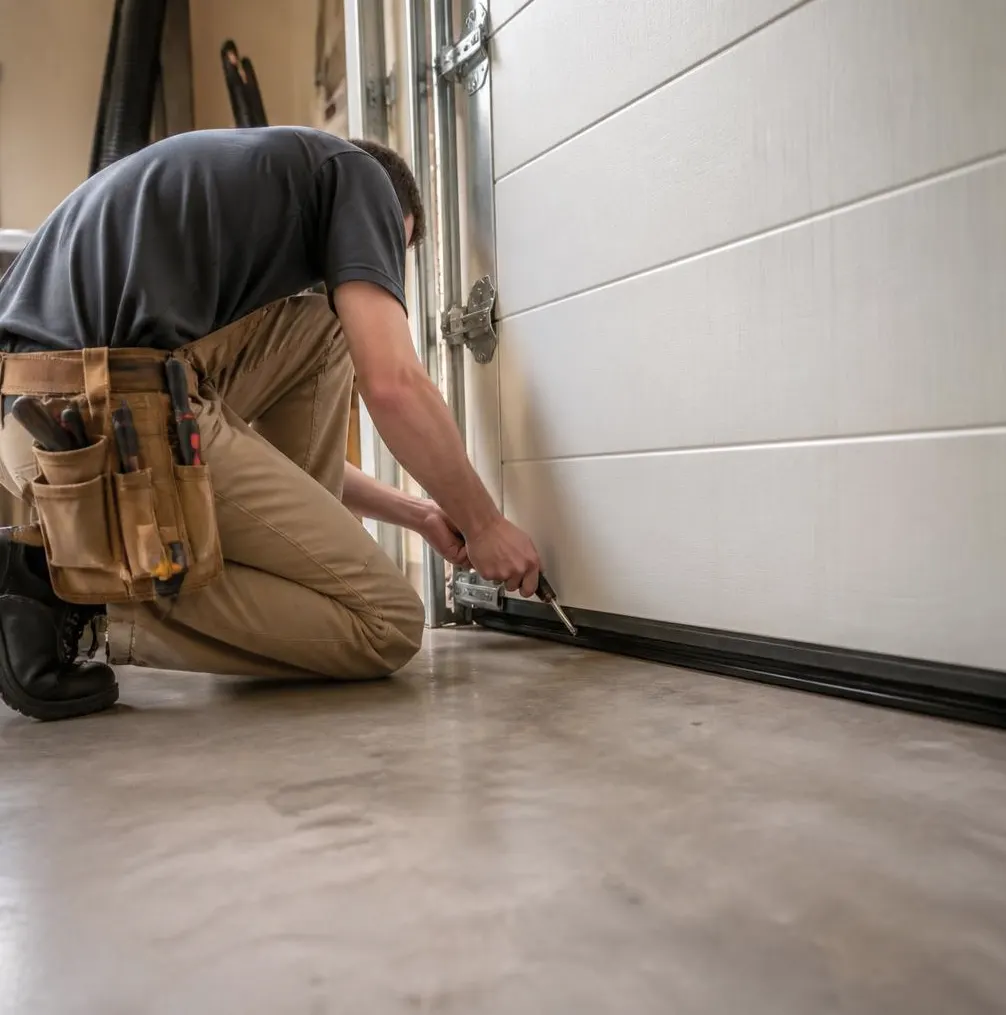
Crouch down and look at the rubber strip along the bottom of the door. If it's cracked, flattened, or has daylight showing through in spots, meltwater and drafts are getting in. On older garages that aren't fully conditioned space, this is how rodents and moisture find their way in too.
5. Inspect the panels closely, not just from across the driveway
A lot of the housing stock around here still has original wood or early steel doors. Press gently on the bottom panel of a wood door — if it feels soft or spongy, there's rot starting, usually from years of snowmelt sitting against the bottom edge. On steel doors, look for bubbling paint or rust-through at the bottom corners, a common failure point.
6. Test the auto-reverse safety sensors
Close the door and wave a broom handle across the sensor beam near the floor, about 6 inches up. The door should stop and reverse immediately. If it doesn't, or if the sensors are visibly out of alignment (one pointing slightly off from the other), that's a safety issue that needs correcting before the door is used normally — not a cosmetic one.
7. Check the opener's age and battery backup
Ask for the opener's install date if it's available, or check the label inside the housing. Openers over 10–15 years old often lack modern safety reversal sensors or rolling-code security. If there's no battery backup, factor that in — nor'easters here knock out power, and a backup-equipped opener keeps the door usable (and keeps it from needing a manual crank in the dark during a storm).
8. Listen to the hinges and rollers
Open and close the door and listen for grinding or squealing. Check whether the rollers are the old steel type or newer nylon — steel rollers are noisier and wear tracks faster, especially with salt exposure. Worn rollers are cheap to replace but ignored long enough, they damage the tracks too.
9. Check insulation, if the door has any
Knock on the panel — a hollow sound usually means a single-layer, uninsulated door, common in older construction. That's not a dealbreaker, but it's worth knowing before winter, since an uninsulated door attached to the house can make the space above or beside the garage noticeably colder.
When to call Hamilton Garage Door
If the balance test fails, the springs look worn, or you're not comfortable testing any of this yourself, that's exactly what a pre-purchase inspection from us is for. We'll check spring tension, opener settings, and track condition, and tell you honestly what's a quick fix versus what should be negotiated into the sale. If you move in and find a spring that's clearly failing or a door that won't seal against the cold, our Spring Replacement and Garage Door Maintenance services are built for exactly that — getting an older door ready for a Central New York winter instead of waiting for it to fail in January.
If you're closing on a home anywhere from Hamilton to Earlville, Morrisville, Cazenovia, Madison, Sherburne, Brookfield, or Hubbardsville, give Hamilton Garage Door a call before or right after closing — we'll make sure the door you're inheriting is one you can trust through the first winter and beyond.